Thursday, December 30, 2010

Home for the Holidays

by Michael Hofferber. Copyright © 2005. All rights reserved.

Home for the holidays.

That was always Grandma’s house as I was growing up. For nearly twenty years, no matter where we lived or what the circumstances, our family made a regular pilgrimage to Grandma Amelia’s home, a clean and spacious ranch-style structure on the rural edges of Billings, Montana.

Grandpa Ben lived there too, of course, but it was always “Grandma’s house.” She was the one who kept up the place and made arrangements, answering the phone and greeting us at the door with hugs and kisses.

Continued at...
Home for the Holidays

Michael Hofferber
Rural Delivery
Grandma's House

Monday, December 20, 2010

The World in Hattie's Jars

by Michael Hofferber. Copyright © 1993. All rights reserved.

Hattie Gietzen holds a piece of the Holy Land in her hand. In the other palm she grips part of Hawaii. And on shelves and bureaus throughout her tidy Idaho home are portions of Belize, Death Valley, Alaska, Panama, Saudi Arabia and the Gulf of Mexico.

This 89-year-old woman has been collecting sand from all over the world for more than 20 years. The samples -- hundreds of them -- are gathered in small baby food jars marked with neat labels identifying the source of the sand.

"This one here is from the oldest pyramid in Egypt," she says, holding up a jar of white sand. "My niece brought me that one in 1983 after she went on a tour over there."

Continued at... The World in Hattie's Jars

Michael Hofferber
Rural Delivery
Out of the Past
Beach Walkway Path

Sunday, December 19, 2010

The Sun Stands Still

by Michael Hofferber. Copyright © 1997. All rights reserved.

This is as dark as it gets: fifteen hours of night, give or take a few minutes, at latitudes near the 45th parallel and nine hours of daylight, if you're lucky.

It is the week of the winter "solstice," a word derived from Latin meaning "sun stands still." For two or three days the sun seems to rise and set in the same places on the horizon and at the same times, as if uncertain whether to continue on its southward journey or to start creeping north again.

Ancient peoples once kindled huge bonfires on these nights, designed to urge the sun to burn warmer and longer. Among the Goths and Saxons, this tradition evolved into the Yule Girth Festival. Night fires still burn for some folks at solstice.

Imagine not knowing how the sun's decline was related to the tilt of the Earth in its orbit. Could the southerly retreat continue until the sun vanishes altogether, as it does during a full eclipse? Or could it get stuck here, in this track across the heavens, locking these lands into eternal winter?

Continued at... The Sun Stands Still

Michael Hofferber
Rural Delivery
Solstice Sunset atop Midnight Dome, Dawson City, Yukon, Canada

Friday, December 17, 2010

If It's Thursday Night, It's Bullseyes

by Michael Hofferber. Copyright © 2007. All rights reserved.

On Thursday nights in late winter the three taverns facing the railroad tracks in Shoshone, Idaho, are comfortably warm and inviting. Inside any of the establishments customers will be lined up at the bar and scattered among dimly lit tables. Reba will be wailing from the juke box and a crowd will have gathered around the electronic dart machine at one end of the room.

"Pock!" goes a soft-tipped dart into the board and instantly the machine tallies its score. Then another player toes the foul line.

This sparsely populated niche of southern Idaho is a long way from England, where throwing darts at a circular, numbered board is a passionate pasttime. But out of every eighty-five residents in the all-rural Lincoln County at least one is a competitive dart-thrower.

Continued at... If It's Thursday Night, It's Bullseyes

Michael Hofferber
Rural Delivery
Three Darts in the Bull's-Eye of a Dartboard

Wednesday, October 27, 2010

All Soul's March

by Michael Hofferber. Copyright © 1994. All rights reserved.

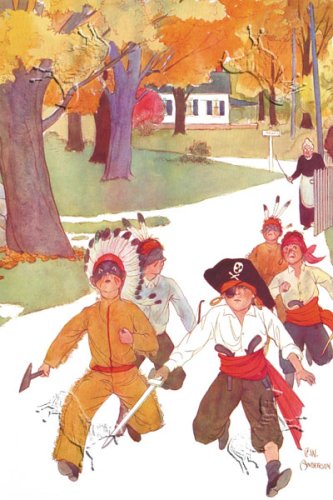
In the crisp chill of October night costumed children toddle down darkened lanes, their tittering voices fending off silence.

They come dressed as ghouls and monsters, aliens of outer space and starship captains from the 25th century. Masked as heroes and demons, wild animals and crazed villains, our youth knocks upon the doors of strangers demanding treats.

In Ireland, once upon a time, it was the adults who dressed up as imps and fairies on All Hallow's Eve, painting their faces and shrouding their bodies.

This was the year's end, the close of summer, and the spirits of all who died of late were said to wander the night looking for some person or animal to inhabit on their way to the afterlife. It was possession the spirits were after and possession the Celtic people wanted to avoid.

Continued at... All Soul's March

Michael Hofferber
Rural Delivery
Out of the Past
Artwork: Halloween Boys

Saturday, October 16, 2010

Hippie Hoedads

by Michael Hofferber. Copyright © 1997. All rights reserved.

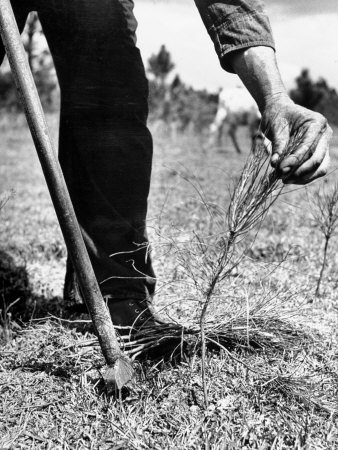
Across the Northwest, from the Olympic Peninsula to the Bitteroots of Idaho, thousands of acres of young Douglas fir and white pine grow shoulder high on land clearcut a couple decades ago. These young forests are the legacy of men and women, the hippies of the 1960s, who fled "back to the land" during the early 1970s and found work as reforestation tree planters.

Like the Okies who headed west after the Dust Bowl years, or the settlers who crossed the continent along the Oregon Trail, the long-haired exodus north from California was fueled by idealistic dreams: unspoiled nature, cheap farmland, communal living, freedom from authority. They didn't anticipate depressed local economies, high unemployment, or antagonistic residents.

Continued at Hippie Hoedads
Michael Hofferber
Rural Delivery
Artwork: Man Planting Pine Tree Seedlings by Hansel Miet

Wednesday, October 13, 2010

Not Far Removed

by Michael Hofferber. Copyright © 1998. All rights reserved.

Every day for three years I joined millions of people on a mass migration between home and work in the crowded urban corridor between the suburbs of New Jersey and the skyscrapers of midtown Manhattan.

My wife was in graduate school at Rutgers University and I was working in an office halfway up the Empire State Building. My memories of those years are a succession of bus rides, train trips, taxi fares and street scenes; the smell of stale smoke, urine, fried meat and diesel exhaust is imprinted in every reflection.

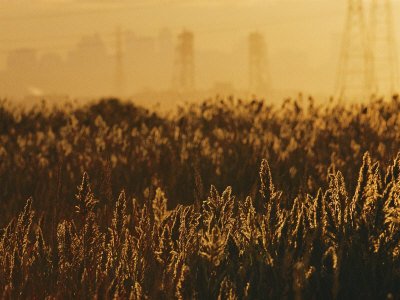
Between the tunnels that fed us into the thick of midtown and the snarl of traffic circles, train stations and Turnpike toll booths that marked a steady succession of townships and cities, was a shock of open space: marshes, weeds, boggy dumps, mud flats, tall grasses and protruding boulders.

Like most other commuters, I presume, I looked out the window and thought "wasteland." Undoubtedly despoiled with toxins and polluted beyond repair, it was obviously a place without worth or it would have long since been developed.

Almost a dozen years later, I realized I missed something. New Jersey nature writer John Quinn produced a convincing study of the Hackensack Meadowlands showing that despite its poor reputation, the area supports a vital ecosystem of birds and fishes and lush plant life far more extensive than anyone would imagine.

Ducks of many species migrate through the Meadowlands; some even reside there. Striped bass are common in these waters, though folks are warned against catching them for the frying pan. Several species of frogs survive in the brackish waters and peregrine falcons have been nesting on factory smokestacks.

Titled "Fields of Sun and Grass," Quinn's skteches and observations of the Meadowlands reveal a rural place not far removed from the urban congestion of Times Square.

At one point, he climbs a graffiti-decorated rocky outcrop called Snake Hill that overlooks forests of chimneys and standpipes, marshy flatlands, and a convoluted tangle of roadways branching off the steady stream of the New Jersey Turnpike that fades into a horizon of hazy buildings.

"Sitting there in the November sun, assailed by the noise of a hundred thousand machines, the collective voices of perhaps a million people and a half a billion birds, I found my convictions as a naturalist challenged by the overwhelming visual and auditory assault," Quinn reports.

"I saw and heard this exultation not as a craven offense against nature but rather as a spectacular confirmation of it."

The Meadowlands is a toxic place, defiled by some of the worst byproducts of 20th century society, and yet it lives and thrives and, in some places, is being restored. It demonstrates how nature incorporates the works of man, however complex and intrusive, and pursues its own agenda.

I once believed that what we call "rural" and what we know as "urban" could be clearly separated. Now I'm not so certain. Even small towns are sporting espresso bars these days and the most remote ranch may be linked via the Internet to daily trading on Wall Street.

Meanwhile, there are crops being grown on rooftops in every major city and more urban dwellers are taking an interest in being frugal and self-reliant. And, as Quinn demonstrates, there remain pockets of open space near the most densely populated cities where a person can stretch out and, for a few moments at least, feel what it's like to be in the country.

Michael Hofferber
Rural Delivery
Not Far Removed
Artwork: The Marshes of the Meadowlands Glitter with Sunlight
Fields of Sun and Grass